Showing posts with label one-way. Show all posts

Thursday, March 29, 2012

Coming right at you: Podcasts and RSS feeds

Thus far, most of the technologies we have talked about have been primarily social media platforms, which tend to be multi-way communication (lots of people or institutions sharing with one another).  Services like Twitter, Historypin, and Google+ consist entirely of what the users, whether institutions or individuals, generate and share.  Now we will turn to some things that are a bit more one-way, from museum to visitors: podcasts and RSS feeds. 


RSS Feeds

RSS stands for RDF Site Summary (RDF stands for Resource Description Framework).  It is sometimes referred to as "really simple syndication."  Essentially, RSS is a delivery system; it is a service that gathers content from blogs, Facebook pages, even video or audio broadcasts (such as podcasts), and brings it all to one place through a "feed."  The feed comes to your computer or mobile device using an RSS software program, or you can receive the content by e-mail.

You've probably seen the orange RSS icon on many websites and blogs (such as this one); sometimes the icon is labeled "xml" instead of RSS, but it serves the same function.  The icon indicates where you can "subscribe" to something, which means it will appear in your RSS feed whenever new content is added by that blog, website, or other service.


Your RSS feed will come to your computer or mobile device once you install an RSS reader and then subscribe to websites, blogs, or other sources.  The RSS reader scans all the sites you've subscribed to, and whenever something new appears it downloads the content to your device.  This way you don't have to visit all the individual sites you're interested in; everything just comes to you.
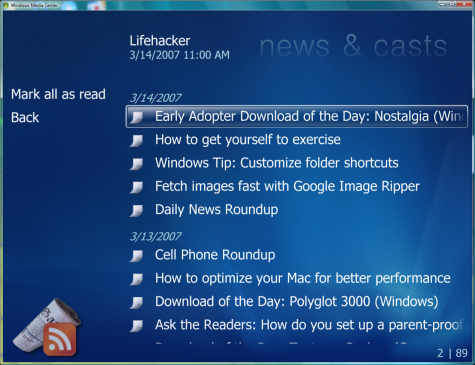
A typical RSS feed reader, photo courtesy of Lifehacker.

RSS feeds can apply to many of the social media we have discussed in previous posts.  For a museum, the employee who serves as the blogger, Facebook page author, or webmaster can make the institution's content available through RSS by providing a subscription link.
  • In Blogger, as we've done here, it's as simple as adding the RSS subscription "gadget." 
  • Other blog templates, like Tumblr and Wordpress, have a similar feature that can be added.
  • In Facebook, the RSS capability is an app that you can add to your page.
  • To enable your museum's website such that people can subscribe to its updates via RSS, there are free services like RSSpect that can help you set it up.
The MOMA, the Philadelphia Museum of Art, the Royal Ontario Museum, and numerous others have set up full pages within their websites dedicated to RSS subscriptions.  More museums are adding this feature nowadays.  For more reading, this review has a good description with more details than I've gone into here.


Podcasts

The word podcast is a combination of broadcast and iPod; it is a pre-recorded audio or video program that goes right to your computer or mp3 player.  Tee device doesn't have to be an Apple iPod or iPhone, unless you want to use the iTunes podcast store.  You can sign up to automatically receive the podcasts of a regularly-produced program, or you can go to the source's website and download podcasts individually.

Sample view of the iTunes Store podcast listings

Creating a podcast involves some work, but it's not that difficult to do.  You need a good video/audio recording device with a microphone to pick up sound clearly and minimize background noise.  You need an interesting topic and a clear, succinct script with which to explain it.  And you need just enough sound- or video-editing software and knowledge to splice the recordings into something cohesive that visitors will understand and enjoy.

Liz recently created a podcast about museum technologies, which she will talk about in her next post.

Museums can use the podcast format to serve their visitors in a variety of ways:
  • Audio or video tours, such as the National Museum of the Air Force has made; this format makes the content more independently accessible to people who have difficulty seeing or hearing, and it allows visitors to pause or rewind the tour and move at their own pace.  
    • The San Diego Zoo has a cool iZoofari program, which allows visitors to create a customized audio tour of the park.
  • Behind-the-scenes peeks at the internal functions of the museum, the creation of its exhibits, and the development of programs; these kinds of "insider" specials can help the audience feel more like a part of the museum.
  • Informational lectures about recent discoveries, research, and news in the world; there are many good examples among the podcast offerings from the Smithsonian museums
  • Going forward, museums could use podcasts to present ideas for new exhibits and then get feedback from the public (by e-mail, Twitter, etc.) about the topics, themes, objects, and stories that are portrayed, as well as how they are presented.
The Boston Museum of Science, the Monterey Bay Aquarium, and the Design Museum in London, among others, have great podcast pages that list their current offerings.  This page has a fairly good list of museums that offer podcasts; not all the links are up to date, but the listed museums do have podcast pages elsewhere on their websites.

For more resources on podcasting, there's the archives of Podcasting Underground, tips from eHow, and a detailed tutorial from FeedForAll.

Monday, February 27, 2012

Guest post part 2: If I had a dime for every time...

Guest post by Erin Blasco, public programs coordinator and manager of the National Postal Museum’s Facebook and Twitter accounts

If I had a time for every time I heard, "Social media communities grow quickly and are basically self-sustaining," I’d be a pretty rich museum professional!

But I’d also probably not stop to consider why this statement triggers an instant eye roll. I’d never develop strategies to make conversations about social media more productive. For the upcoming Museums and the Web conference, a group of museum professionals is asking you to do just that: discuss the biggest myths in museum social media in a productive, thoughtful way. For details on why you should participate and how to do this, see the previous post.

Here’s some food for thought related to this statement: “Museum social media communities grow quickly and are relatively self-sustaining.”

· “Social media is a monologue waiting, sometimes fruitlessly, to become a dialogue. Despite that it will grow - doing so around a hub of particularly engaging participants who drive the media by virtue of their skills and depth of (or, diversity of) knowledge. The same drivers found in successful face-to-face conversation.” - @POPinDC

· “I agree that social media communities CAN grow quickly and be relatively self-sustaining if they are built on pre-existing in-person networks or communities of interest. The idea that any social media outlet once opened will automatically (a) gain a following and (b) turn this following into a community is misleading.” - @Museums365

· “Social media helps us engage our members. New species discoveries, job opportunities, we've even live tweeted an expedition” - @labroides

· “I mean, to a certain extent it depends, but self-sustaining SM communities will be the outliers, not the rule.” - @RyanD

What is a “community?”

Members of communities have to share something, whether it’s physical space or interests, often both. If a museum creates a Facebook page and posts images and stories from the collection twice a week, are their followers a community? As a manager of two museum social media accounts, I see evidence of various interest groups within our followers—Civil War buffs, stamp collectors, former postal workers—but they seem like subscribers, not active community members.

On the other hand, members of niche interest groups follow the museum on social media to feed their interests and inform their hobbies. The comments may not buzz with thoughtful debate or the swapping of stories, but the occasional “I used to work at the post office in Rhode Island” followed by “Me too!” shouldn’t be belittled—that’s a human connection! By sharing our collections and stories in a social space, the museum invited community members to hang out and do whatever it is that communities do.

How do you define social media followers? Is forming a “community” a goal at your institution? Or is it more about increasing followers?

Growing quickly?

There’s a big emphasis on follower numbers in social media, maybe because it can be challenging to gauge success through other metrics. Under what circumstances do social media communities grow quickly? And is quick growth always desirable? At my own institution, we measure annual growth and set steadily increasing benchmarks but the numbers we pick are fairly arbitrary and we aren’t sure exactly how (or why) to impact the rate of growth. I’ve noticed that museum tweetups, which typically have limited space, are sought-after experiences partially because they’re so exclusive. What if we capped follower numbers at 500 and asked each new follower to complete a three question application? Would we have a more dedicated, engaged community or would everyone just get cranky?

Is quick growth important to your museum? If not, what metrics are more important? Have you seen a community grow exponentially or not at all?

Self-sustaining?

Very few museum professionals would expect a monthly “chat with a scientist” program to be completely self-sustaining but somehow that expectation is often applied to social media communities. Why do you think this is?

I agree that there are self-sustaining communities online. I recently had a question about my goldfish tank and joined an online forum for people who are passionate about fish. These folks had invested time and money in their own tanks and definitely considered themselves members of a real community that they worked hard to sustain. Could art fans, history buffs, or other museum followers reach that level of commitment and interaction on a museum social media site to the point that it would sustain itself? Is that the goal? Is interest in “self-sustaining” communities just another way to say that social media isn’t worth staff time and resources?

So share your reactions, experiences, case studies, and favorite links!

Sunday, February 5, 2012

Mapping a route through the tech world

Let's face it, there's an awful lot of technology out there.  There are devices and applications and tools that give us a dizzying number of ways to connect, share, and create information.  As emerging museum professionals, we will be part of the sea-change that museums are currently experiencing; some welcome technology, some fight it, some don't know what to do with it.  

To start off this project, we decided to organize our brains by drawing up a map of what's out there and how we can categorize it in terms of museum applications.  We ended up with two broad categories, which overlap somewhat: user-generated and institution-generated.


Alongside that grouping, we noticed that these various tools were either one-way or multi-way.
  • One-way channels of information take content from one entity and broadcast it for public use, but without the option for users to add their own content or responses beyond commenting.  Most things in this category, like websites, mobile apps, and Podcasts, allow information produced by institutions to be consumed by individuals.  A few exceptions, like Yelp, are the opposite: one-way reviews from individuals back to companies.
  • Multi-way formats, such as social networking and other information-sharing sites, allow anyone, whether an individual or an institution, to upload and share content.  So a museum can post a tweet about something interesting, and users can respond by commenting, sharing it with their friends, or uploading their own related content.  Likewise, the museums can respond to postings from their followers and users.  
As another interesting framework, we found this set of "social technographics" from Nina Simon's book, The Participatory Museum, which she cited from a 2009 study by Forrester.  Essentially, online web-users fall into these six categories, which overlap:
  1. Creators (24%) who produce content, upload videos, write blogs
  2. Critics (37%) who submit reviews, rate content, and comment on social media sites
  3. Collectors (21%) who organize links and aggregate content for personal or social consumption
  4. Joiners (51%) who maintain accounts on social networking sites like Facebook and LinkedIn
  5. Spectators (73%) who read blogs, watch YouTube videos, visit social sites
  6. Inactives (18%) who don’t visit social sites
In order for museums to effectively use technology, we think it's important to start with an understanding of these statistics.  While there are creators out there who generate original content, there are many more people who comment, organize, and observe what is put out there.  

Going forward in this blog, we will be exploring the technologies laid out in the map pictured above.  In some cases, we will be trying out certain websites or tools for the first time, so we will provide a first-timer's perspective and review, as well as ideas for how the tools could be used by museums (or how it's already being utilized!).  Additionally, we will interview experienced practitioners in the museum-technology field, conduct research, and provide case studies and additional resources.

We welcome any and all feedback, comments, participation, and other things of that sort from you, our readers.